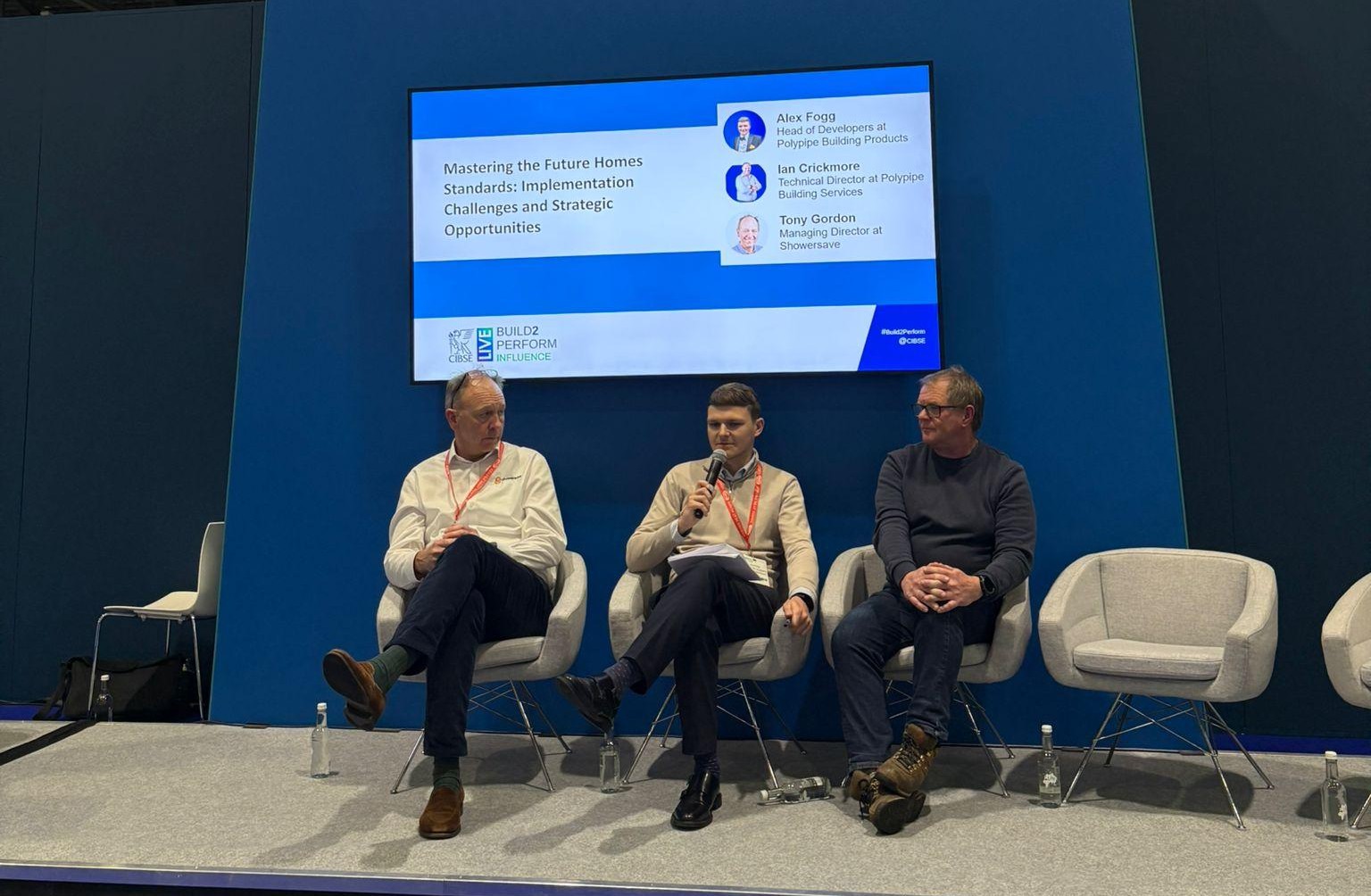

At this year’s elementalLONDON event, Polypipe Building Products, Head of Developers, Alex Fogg, joined an expert panel at the CIBSE Influence Theatre to discuss the Future Homes Standard (FHS) and its implications for the UK’s housing sector.
Alongside Ian Crickmore, Technical Director at Polypipe Building Services, and Tony Gordon, Managing Director at ShowerSave, the session explored how manufacturers, developers, and supply chains can work closely to meet future regulatory, environmental, and practical challenges in housebuilding.
Have a read of our key takeaways from the panel discussion, below.
Delivery through partnership
A core focus of the panel discussion placed a spotlight on the Vistry Innovation Centre – a physical, life-sized house at the Vistry Group’s East Midlands site – where Polypipe Building Products worked closely with Polypipe Building Services and ShowerSave to showcase a space-saving, wastewater heat recovery solution. The collaborative project reduced the footprint of the installation by around 50 – 60%, helping Vistry to address a common practical challenge in modern housebuilding: limited space for increasingly complex heating and plumbing systems.
By integrating drainage and wastewater recovery into a single, modular unit, the solution not only saved valuable space but also sped up installation by reducing on-site labour, and improving building quality. The approach taken in completing the Vistry Innovation Centre was used to highlight how cross-industry collaboration can effectively accelerate progress towards decarbonising future housing stock.
Championing collaboration and integration
Further reflecting on Polypipe Building Products’ involvement in the Vistry Innovation Centre, Alex took the opportunity to highlight the role of collaboration between product manufacturers and developers as the sector approaches the implementation of the FHS. Alex mentioned that being part of the Genuit Group, Polypipe Building Products can draw on a variety of expertise across its division – from climate management and drainage, to sustainable heating and ventilation.
On this, Alex explained: “We don’t always know where there’s a problem until someone brings it to us.” In essence, this underscores the importance of engaging manufacturers early on within the design and concept stage to streamline the construction of future-ready, FHS-compliant homes.
Preparing for the introduction of the Future Homes Standard
Panellists were in agreement on the wider challenges and opportunities facing the housebuilding sector as the Future Homes Standard approaches. These include:
· Industry readiness to install low-carbon heating systems, like heat pumps, at scale.
· The need to plug the skills gap and upskill installers in new technologies and systems.
· The ongoing cost pressures facing developers especially, and the importance of delivering quickly without compromising on quality.
To address these challenges, Alex outlined Polypipe Building Products’ commitment to supporting the upskilling of the workforce through practical steps, including partnerships with education providers and its BPEC Accredited development courses – ensuring installers are ready to deliver the homes of the future.
Taking a unified step towards a low-carbon future
Concluding his thoughts, Alex reaffirmed Polypipe Building Products’ belief that collaboration across the wider supply chain – from manufacturers, through to developers and installers – is key to meeting the Future Homes Standard in practice and meeting the UK’s ambitious net-zero ambitions. By bringing together innovative, practical design and measures to close the skills gap, Polypipe Building Products aims to play a key role in shaping a smarter, more sustainable housing sector.